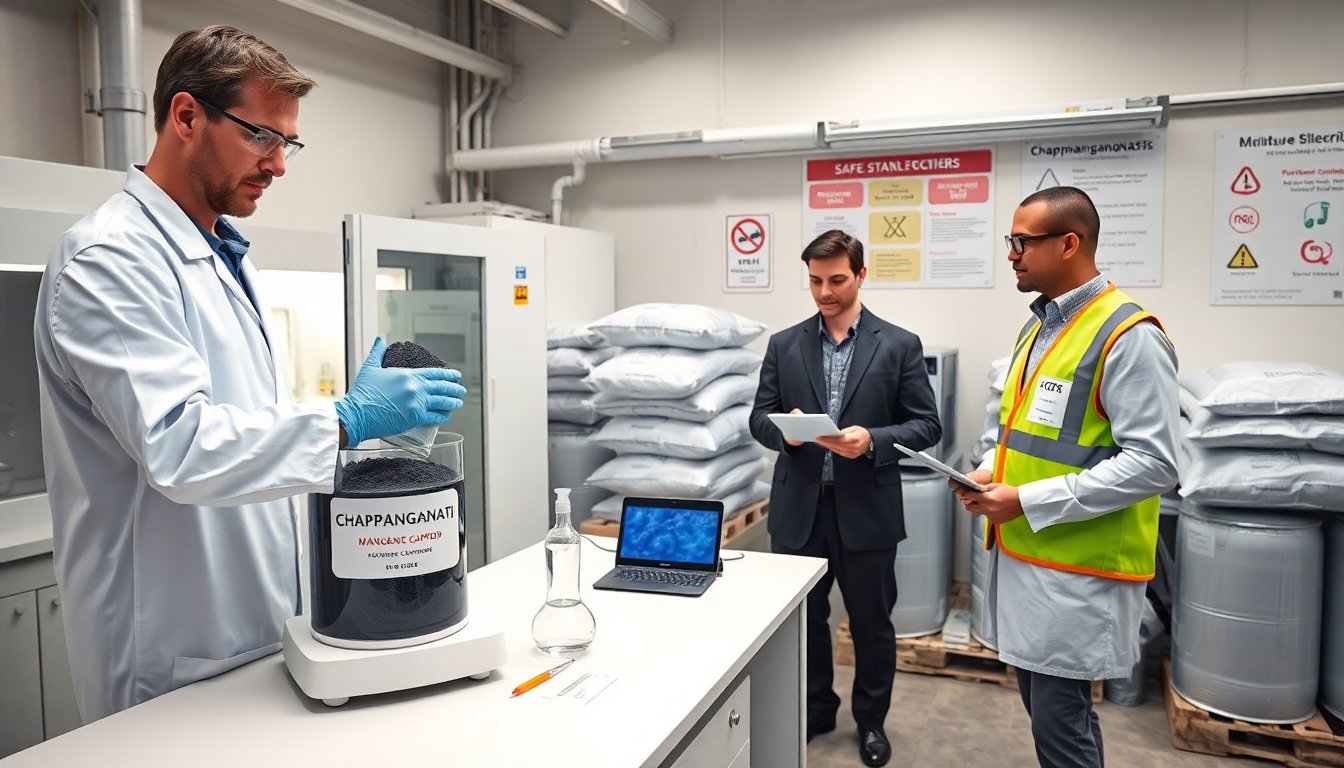
Chapmanganati is a manganese-based compound used in industry and research. It appears as dark crystalline powder or granules. It reacts with oxygen and acids under certain conditions. It forms different hydrates and salts. This article describes the chemical identity, main uses, and safe handling practices for chapmanganati in 2026.
Table of Contents
ToggleKey Takeaways
- Chapmanganati is a manganese-based compound widely used in industry and research for applications like pigment production, battery cathodes, and catalysts.
- It appears as dark crystalline powder or granules and reacts with oxygen and acids, requiring careful handling as an oxidizing agent.
- Safe handling of chapmanganati includes using protective gear, controlling dust, proper storage away from acids and organics, and following spill and fire response protocols.
- Chapmanganati’s quality varies by grade—technical, reagent, and specialty—each suited for different industrial or laboratory uses.
- Environmental precautions are critical because chapmanganati releases can harm aquatic life and increase manganese levels in soil and water.
- Regular monitoring, staff training, and compliance with safety regulations ensure safe and effective use of chapmanganati in 2026.
What Chapmanganati Is — Chemical Identity, Physical Properties, And Common Forms
Chapmanganati is a manganese-containing inorganic compound. Chemists identify it by its empirical formula and CAS number when they register it. Analysts classify it as an oxidizing salt in many databases. The solid form appears as dark grey to black crystals. The powder form appears as fine black granules. It dissolves partially in hot water and more readily in dilute acids.
Chapmanganati shows variable oxidation states. It commonly presents manganese in the +3 or +4 state. The compound releases oxygen under heat or strong acid. The compound melts at a high temperature and decomposes rather than vaporizes. The compound forms stable hydrates in humid air. The compound can appear as mixed salts with sodium or potassium in commercial samples.
Suppliers sell chapmanganati as technical grade, reagent grade, and specialty grade. Technical grade contains more impurities and suits bulk industrial use. Reagent grade offers higher purity for laboratory work. Specialty grade meets tighter specs for electronics or catalysts. Safety data sheets list the composition, impurities, and recommended storage for each grade. Analysts confirm identity by X-ray diffraction, infrared spectra, and elemental analysis.
Users should treat all unknown samples of chapmanganati as potential oxidizers. The material may react with organic matter and reducing agents. The material can generate dust that can irritate lungs and eyes. The material requires labeled containers and controlled handling to prevent accidental reactions.
Practical Uses And Industrial Applications Of Chapmanganati
Manufacturers use chapmanganati in pigment production and ceramic glazes. The compound adds color and stability to high-temperature glazes. It acts as a flux in some glass formulas. Plants use chapmanganati as a precursor to manganese oxides for battery cathodes. The compound serves as a catalyst precursor in oxidation reactions in chemical synthesis.
Metal finishing shops use chapmanganati in plating baths and corrosion inhibitors. The compound helps deposit manganese-rich layers on steel. Battery makers convert chapmanganati to manganese dioxide for alkaline and lithium batteries. The compound supports electrode performance when manufacturers control particle size and phase.
Researchers use chapmanganati in material science to create mixed metal oxides. Labs test it as an additive in solid oxide fuel cell electrodes. Environmental firms use chapmanganati to remediate contaminants by promoting oxidative breakdown of organics in controlled systems. Construction material companies test low levels of chapmanganati to alter cement color and early strength in specialty mixes.
Suppliers ship chapmanganati in drums, bags, and bulk containers. Companies adjust packaging to reduce moisture uptake and limit dust. Purchasing teams request certificates of analysis for industrial batches. Quality teams verify trace metals and particle size. Engineers design process feeds to limit exposure to reducing agents and flammable organics. Safety professionals require plans for accidental spills and thermal decomposition.
Health, Environmental Risks, Detection, And Safe Handling Practices
Exposure to chapmanganati can harm health if staff inhale dust or ingest the compound. Animal studies show high manganese intake can affect the nervous system. The material can irritate skin and eyes on contact. Facilities must monitor airborne concentrations and enforce respirator use for dusty operations.
Workplaces must provide local exhaust and use enclosed systems for transfer. Staff must wear gloves, goggles, and protective clothing when they handle chapmanganati. They must wash skin after contact and change contaminated clothing. Emergency eyewash and shower stations must sit near handling areas.
Environmental releases can raise manganese levels in soil and water. Elevated manganese can harm aquatic life and affect water taste. Facilities must treat process water and capture solids before discharge. Waste handlers must classify spent chapmanganati under local hazardous waste rules. They must label containers and use licensed transporters for disposal.
Analytical labs detect chapmanganati and its transformation products by ICP-MS for total manganese and by XRD for solid phases. Colorimetric tests identify manganese in field samples at higher concentrations. Routine sampling helps track process losses and environmental release.
For storage, keep chapmanganati in cool, dry, well-ventilated rooms away from acids and organic materials. The material should sit on pallets and in sealed containers. Staff must ground and bond containers when they transfer powders to reduce static risk. Do not store chapmanganati near strong reducers or combustible materials.
In case of a spill, isolate the area and control dust with gentle wetting or use a HEPA-filter vacuum. Collect the material in labeled containers for proper disposal. Do not flush large amounts to drains. If a fire involves chapmanganati, firefighters must use water spray or foam and approach from upwind. They must wear full protective gear and SCBA because decomposition can produce toxic gases.
Companies must train staff on chapmanganati hazards and maintain updated safety data sheets. Regular audits and health surveillance help detect exposure trends. Clear labeling and documented procedures reduce accidents and ensure compliance with 2026 regulations.